Friday, April 15, 2011

Knowing a New River: Fly Fishing Southeast Pennsylvania's White Clay Creek

What does it mean to "know a trout stream"? Although this vague and strange grammatical construction is well known and often muttered, it nevertheless raises a set of epistemological problems: how can you really "know" anything?, can you even "know" a thing like a river? if you can, how long does it take? one trip, four trips, years? does it mean having success catching fish? does it mean you are no longer taken by surprise at any given moment on the water? do you have to know the entire layout of the waterway?

I don't have the answers to these questions. In fact, it seems that each person would define "knowing" a river in a different way. For me, it's about comfort: can I go to a river, with no planning, at any time of year, and still catch trout on the fly? If the answer to this question is yes, I probably "know" that river. It takes me quite a bit of time, though, to arrive at this state. I need to see the stream in low water, in flood stage; I need to see it on 90 degree days when the sun pounds down on the water; I need to see it when it snows, and when ice blocks out different sections; I need to be there when it rains and when it sleets; I need to have success and failure even out, creating the expectation of trout on the fly; and, finally, I need to write about it.

That being said, I'm "getting to know" southeast Pennsylvania's White Clay Creek. Three branches of this Delaware Bay watershed flow near my house, and over 10 miles of the stream are stocked by Pennsylvania and Delaware. Driving distance isn't a factor; indeed, a short half-mile walk brings me to the stream's un-stocked West Branch. And in the last few weeks, I've visited various stretches of the White Clay over 10 times.

On one of my trips, it was cold, wet, and dreary. Five minutes after I got there, it started to rain. I could literally watch the water getting muddier by the minute. So I got out my fly box, picked out a cone-head muddler minnow, and tied it on. The fly's gold wire, wrapped tightly around its mid-section, cut through the murky water, and trout after trout smacked it. It was a wonderful time (I've always loved fly fishing for trout in the rain). On another trip, however, the sun was bright and the temperature was nearing 70 degrees. A perfect day to head to the river, right? The trout, though, were not quite active, and they were skittish of any shadow I cast on the water. After nymphing for awhile, I ultimately tied on a light colored dry fly, and blindly drifted it down the current. I tend to fly fish underwater, so I was thrilled when a smallish brown trout rose from the bottom to strike the dun imitation. Immediately after catching that trout, I left the White Clay, content and satisfied.

Other trips to the White Clay featured Delawarian fly fishing, enticing trout with small wooly bugger streamers, and a few bald eagle sightings. Now, as I contemplate driving to the special regulation, delayed-harvest area near Landenberg, PA, the process of "knowing" the White Clay Creek is coming to an end. I've experienced the river in different conditions, gained familiarity with all of its various branches, and learned its hatch patterns for the summer, fall, winter, and, finally, spring. I think I can say, I know the White Clay Creek...at least a little bit.

Image #1: Catching a trout in Delaware
Image #2: Stonefly nymph!
Image #3: White Clay brown trout

(Remember to check out my new guiding website at www.poconoflyfisher.com and follow me on Twitter by clicking the following button: Follow Slippery_Trout on Twitter )

Thursday, April 14, 2011

Now Officially Guiding Fly Fishing Trips in the Poconos and Northwest New Jersey

For those of you who have loyally followed this blog, my decision to formally create a fly fishing guiding website likely comes as no surprise. It's something I've been doing for a number of years now, and I've decided to consolidate that part of my fly fishing life in a professional way. So please visit www.poconoflyfisher.com to learn more about my "new" guiding services.

This new website will in no way impede the nature writing that I do on this blog. Guiding and fly fishing blogging are two distinct aspects of one wonderful sport.

In addition, this blog now has a Twitter account. You can access it by clicking on the following button:
Follow Slippery_Trout on Twitter

Monday, April 11, 2011

Trout in Unexpected Places: Fly Fishing Northern Delaware

Northern Delaware is a diverse and pretty region. Indeed, it boasts some of the finest museums in the country, beautiful parkland, stately colonial homes, and the DuPont industrial complex. It is known for many other reasons, too, and people have been enjoying its wild scenes since the native Algonquians hunted along the Delaware Bay and the Dutch, Swedish, and English colonists settled the area in the early 17th century. And, somewhat surprisingly, it contains miles of trout-stocked waterways.

The cool waters and clay-bound shorelines of the White Clay Creek, Wilson Run, Pike Creek, Mill Creek, Christiana Creek, and Beaver Run receive annual stocking regimens, and the season takes off in the month of April. Because these streams become quite warm in the summertime, the state only provides trout in the early spring, and it actively encourages participants to keep their catch. In addition, the state is not shy about stocking big fish, and many large rainbow, brown, and golden rainbow trout patrol the deep pockets of the aforementioned rivers.

Over the last few weeks, I've been driving south down Pennsylvania's New London Road (PA Route 896), turning left onto Chambers Rock Road, and parking along the banks of the pretty White Clay. The Pennsylvania-Delaware borderline is not far upstream from this spot, and it cuts somewhat perpendicularly across the creek. This geographical quirk is known as the Twelve-Mile Circle, a demarcation that takes New Castle as its center and extends outward 12 miles in all directions. Because of the difficulty of surveying this type of border, Delaware has had disputes with a number of states throughout history, including Pennsylvania (over an area known as the Wedge, where the Twelve-Mile Circle and Mason-Dixon Line overlap), New Jersey (a small part of the New Jerseyean peninsula is technically Delawarian land, and the two states have argued in court over this issue as recently as the late 2000s), and Maryland (where the Arc Line and North Line of the Mason-Dixon Line are not congruent). Because of these strange delimitations, the state border on the White Clay Creek is not confined to the shoreline, nor is it drawn down the middle of the stream. Instead it arcs, ever so slightly, across the river. Enterprising anglers can thus cast their fly lines over a state border (if you are a history/geography obsessed person like myself, you'll appreciate the novelty of this undertaking).

During my fly fishing expeditions, I've found that muddler minnow streamers and stonefly nymphs produce in many of these Delaware streams. For fishermen that prefer lures and spinning tackle, I'd suggest Rapalas fished deep down in the current. Always remember to fish underneath any clay cliffs and sycamore root systems you might see.

Although Delaware is not necessarily synonymous with excellent trout fly fishing (shad and saltwater options are other stories for other days), it nevertheless offers some pleasurable and eye-catching trout opportunities. If you live in Newark, Wilmington, or any other spot near New Castle County, I strongly encourage you to give the nearby rivers a try.

Image #1: The White Clay Creek near the Delaware-Pennsylvania border.
Image #2: The White Clay Creek south of Chambers Rock Rd.
Image #3: A field of lesser celandine in bloom at the White Clay Creek in Delaware.

Friday, March 25, 2011

Fishing Book Excerpt: Fly Fishing for Lake Erie Steelhead

Here's another excerpt from a long-form project I'm currently working on. Check back for more in the coming days and weeks.

I’m always struck by Pennsylvania’s fishing diversity. In the southeast, the state offers access to the Delaware Bay, where enterprising anglers can fish for massive striped bass. To the northeast, the Pocono Mountains provide excellent wild and stocked trout opportunities. Central Pennsylvania contains some of the best limestone, wild brown trout streams in the entire country. Slicing the state in half is the Susquehanna River, a large, relatively flat, body of water that possesses a renowned smallmouth bass fishery. Located nearby, Raystown Reservoir, the biggest lake circumscribed within the state, owns state records for striped bass and Atlantic salmon. And, finally, the far northwestern section of the Keystone State has over 40 miles of Lake Erie shoreline. The lake and its tributaries have combined for eight state records, including rock bass, yellow perch, Chinook salmon, coho salmon, pink salmon, brown trout, lake trout, and, of course, steelhead rainbow trout.

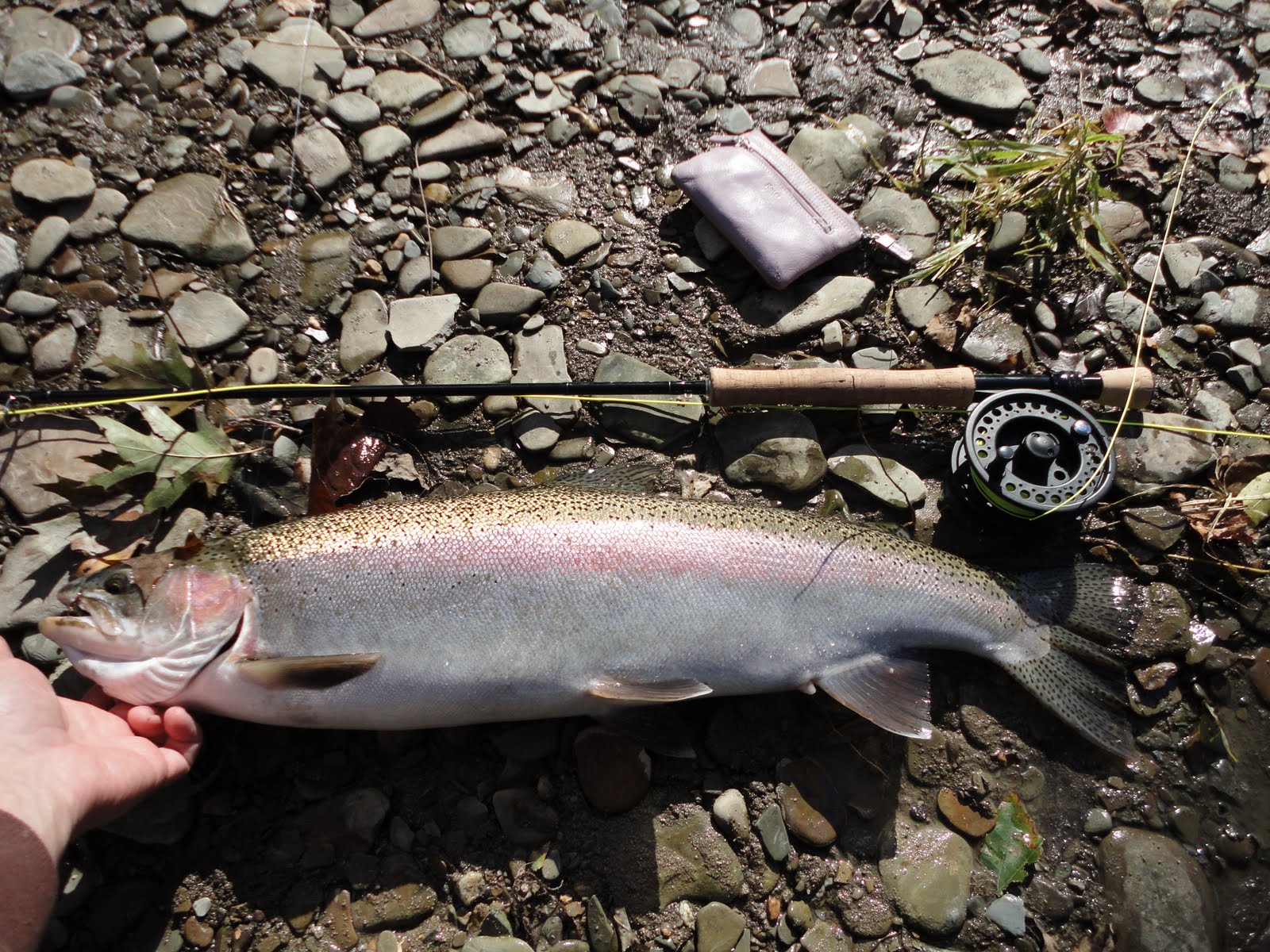
It was the steelhead that drew me to Erie County in March of 2010. This particular type of rainbow trout cast its spell on me about five years ago, when I visited my best friend during my college’s fall break. He went to Edinboro University, a school located about 20 miles from the Great Lake. I was anxious to see Lake Erie for the first time, so we decided to take a drive up to the lake the first day I arrived. On our ride along Pennsylvania’s gorgeous Route 5, I noticed cars lined up along every river that emptied into Erie. This piqued my interest, and subsequent research revealed that October is one of the hottest months for steelhead fishing. Having never heard of a steelhead, I did more investigating. What I learned changed my fly fishing life forever.

Steelhead are remarkable creatures, alien rainbow trout that dominate the natural Lake Erie setting. They are imports from the American West, anadromous visitors that tantalize anglers with their size, their determination, and their numbers. Born in the many tributaries of the big lake, steelhead venture into Erie after their smolt stage (around one year), where they live until they reach sexual maturity. They then return to the rivers of their birth in order to spawn; it is during this period that anglers most regularly target them. Once they leave the lake behind, and re-enter the tributary streams, they carry with them a tell-tale marker of their journey: a grayish, sometimes light green sheen, often compared to the color of steel, on the top of their skulls.

Because rainbow trout can live for many years, and do not die when they reproduce, Lake Erie steelhead can reach immense physical proportions. Six pound fish are common, and 10+ lbs fish are often catchable. They tend to travel in groups, sometimes with as many as 100 other fish. These packs are mesmerizing: on occasion, they are so populous that a person could walk across a stream on a “steelhead” bridge.

In addition, the sheer physical presence of steelhead produces a maniacal effect on anglers.

Thursday, March 24, 2011

The First Wildflower of Spring: Skunk Cabbage and the Advent of Fly Fishing Season

Just a brief note:
As a fly fisherman, I have the opportunity to see hundreds of different wildflowers each year. The blooming periods for specific flowers also mirror the hatching patterns of different water insects. For example, when trout lily blooms at Penns Creek in Centre County, Pennsylvania, it often means the grannom caddis hatch is underway.

In March, the bloom of skunk cabbage suggests that blue-winged olives are hatching. It also means that trout fishing is about to pick up in earnest.

Above is an image of the first skunk cabbage of the year. Northeast fly fishermen should be tying those baetis imitations!

Monday, March 21, 2011

Ice Fishing 2011 in Pictures

Hello everyone. I apologize yet again for the big gap between posts. I've been busy writing my dissertation, and I haven't been able to devote much time to nature writing. As the wildflowers begin to bloom and the first mayflies start to hatch, I thought I'd wrap-up this year's ice fishing season through a pictorial montage. It was a great year on the ice, and I already miss standing on frozen lakes, pulling tip-ups out of the cold water, and catching fish in the most difficult of conditions.


Image #1: Early season fishing on Blue Mountain Lake
Image #2: A nice largemouth bass from Blue Mountain
Image #3: Blue Mountain Lake
Image #4: A yellow perch, one of my only catches during my first trip to Budd Lake
Image #5: Budd Lake
Image #6: Hemlock Pond
Image #7: A yellow perch, the only fish I caught at Hemlock Pond
Image #8: Mauch Chunk Lake
Image #9: A small chain pickerel from Mauch Chunk
Image #10: A largemouth bass from Mauch Chunk
Image #11: Sunset at Mauch Chunk
Image #12: Budd Lake on the second trip
Image #13: The first northern pike of the year
Image #14: Close-up of the pike
Image #15: The biggest pike
Image #16: My wife on Budd Lake
Image #17: A bass from Monroe Lake
Image #18: A fat chain pickerel from Monroe Lake
Image #19: Probably this ice fishing season's fish of the year, a 4-5 lbs largemouth bass from Monroe Lake

Tuesday, January 18, 2011

Ice Fishing New Jersey's Hemlock Pond

A few days later, I returned to the Water Gap. This time, I had my mind set on a loftier goal: Hemlock Pond. Hemlock is located two miles north of Blue Mountain Lake, and is accessible via hiking/cross-country skiing trails. After thinking about my options, I decided to hike the two miles, carrying all of my equipment either on my back or in my hands. This is what I did to ease the burden: I emptied out my ski-boots bag, and filled it with my tip-ups, ice strainer, water, food, and extra clothing; I then loaded my bait bucket with bait and placed it in an empty, larger bucket that usually contains the bulk of my equipment; and, finally, I broke down my ice-cutting bar into a smaller 2-foot size piece. I placed the bag on my back, carried the bait in my left hand, and the bar in my right.

The only problem, though, was the 10 inches of snow that had fallen the night before. A two mile hike is simple enough, but when you combine ankle-deep snow with undulating elevation, it becomes slippery, difficult, back-breaking terrain. And yet, I remained undeterred. What awaited me at the end of the journey was the promise of a 13 acre pond, at 1200 feet, all to myself.
As I started my climb, I noticed how alive the woods seemed after the freshly-fallen snow. I saw the woodpeckers I heard the week before, their shiny red heads standing out like tiny beacons amid the white background; I noticed bright red holly berries glowing through the undergrowth; I heard the chirping of nuthatches, juncos, and cardinals; and I saw the yellow-green mountain laurel leaves desperately clinging to the mother-plant, attempting in vain to withstand the 15-mph wind gusts that lashed the top of the ridge-line. When I reached the apex of the ridge, I could see out into Pennsylvania, with the rolling hills of the Delaware Valley giving way to the strange flatness of the Pocono Plateau. In the distance, I noticed a few stray water towers and the lights from a nearby ski area.

Besides those interlopers, the landscape seemed devoid of human touch, covered under whiteness. At moments like this, it’s easy to think about things like peace, purity, virginity, and calm. It’s easy to come up with hollow lines about beauty, about place. It’s even easier to note a feeling of smallness in a massive universe. This is what whiteness does to us; it’s what hundreds of years of cultural symbolism have embedded into our collective consciousnesses. Our brides are bathed in white, our babies swaddled in its protective sheen. It is associated with privilege, and with progress. It is all encompassing, and it completely surrounded me as I stood alone, gazing upon the Keystone State from the top of a mountain.

It was then that I remembered the lessons of Moby-Dick, a foundational text in my graduate education. A victim and a victimizer, Herman Melville knew that whiteness had another side, a meaner side, even a darker side, that few of us ever notice. As he wrote over 150 years ago, “Or is it, that as in essence whiteness is not so much a color as the visible absence of color; and at the same time the concrete of all colors; is it for these reasons that there is such a dumb blankness, full of meaning, in a wide landscape of snows- a colorless, all-color of atheism from which we shrink?” At the top of a Kittattiny ridge, I thought of this passage, one I had memorized in college. The all-encompassing whiteness around me suddenly seemed terrifying: what if I broke my leg and I was stranded in the blinding cold, with nothing but the stark white snow to stare at? what does the white snow do to the birds that ostensibly seem so happy? does it cover their food supply up, so that their chirps are nothing more than hunger-shrieks? is it fair that the whiteness can transform an abusive home into a paintable winter landscape so beautiful it brings tears to your eyes? In the end, I thought, does whiteness like this make us all like Melville’s harlot, who paints her face to hide the “charnel-house within”? I wasn’t sure then, and I’m not sure now; but I did become frightened, as the trail extended forever onward, and I could never seem to reach the end of it.

But like all of our strange quests, mine eventually did end. Hemlock Pond was right where the maps said it would be, and I spent the next five hours ice fishing. I didn’t break my leg, get lost, or fall through the ice. I even caught a fish: a solitary yellow perch, about eight inches in length. I emerged from my journey with a sore back, sore feet, and a pound or two lighter. It was a pleasant day, replete with exercise, and I drove back home content with my first attempt at “extreme” ice fishing.

Thursday, January 6, 2011

Ice Fishing New Jersey's Lower Blue Mountain Lake

Yesterday, I traveled 150 miles to the Delaware Water Gap National Recreation Area, where I ice fished New Jersey's Lower Blue Mountain Lake. I had been dreaming of hard-water fishing ever since the cold spells of late November, but a recent warming trend in the northeast delayed my first trip until the beginning of January. I chose Lower Blue Mountain Lake because it sits above 1000 feet, and the extra elevation helps create a little more ice underfoot. Lower Blue Mountain, though, is an isolated public lake that requires deft navigation and a bit of hiking. To my surprise, I had the lake to myself. Think about that for a second: in the middle of ice fishing season, I was alone on a body of water in the nation's most densely-populated state.

While I sat on an island-based rock ledge overlooking my equipment, I attempted to come up with encomiums worthy of this place. And I kept failing. I tried to write in my head, which inevitably led me to start thinking about writing itself (such are the pitfalls of my profession). In particular, I thought about the act of writing about nature - perhaps the most basic of any type of writing. Words and concepts like inspiration, hermeneutics, beauty, alienation, and sublime floated through my head, while the birds sang above, and the fish swam below. I concluded that it is remarkably easy to write about the outside world, with its overwhelming combinations (a brightly-colored blue jay in a barren shagbark hickory tree), and otherworldly constructions (wind-swept wisps of snow blowing on the frozen lake like ghost-snakes). Just look at this blog and others like it: I write about nature and my participation within it, and people I've never met read the post, comment on my writing, and email me. In a sense, the moment I put these words on the page, I become united with readers who encounter or seek the same experiences. And no paragraph or sentence, no poem or novel, no blog-post or article, can convey the way I felt yesterday at Blue Mountain Lake. I'm simply not that good of a writer.

At one point, I focused on the silence surrounding me. I knew I was the only human within miles; I had no cell phone reception, and I didn't bring any other media with me. But then, an airplane would fly over-head, and I would hear its powerful engines echoing off the ridges. Or, I would hear the distant rumble of an ATV or the crack of a rifle, as hunters pursued their quarries. Man-made sounds like these pierced the quiet, and these eruptions showed me that the lake wasn't silent at all. In fact, it was a cacophony: roaring wind, singing jays/cardinals/juncos/flickers, hammering woodpeckers searching for food within the bark of wintered trees, and the thickening, expanding, and separating of the ice. And there I was, all alone at the top of the mountain. I may have caught six fish (three yellow perch, two largemouth bass, and one chain pickerel), but I still would have been endlessly happy if I had caught none.

Friday, December 3, 2010

Long-form Project Excerpt #2

Here's another excerpt from the long-form project I've been doing:

Salmon are majestic fish with a long, storied history. Considered one of the prize catches of early modern English anglers, salmon have been praised, threatened, protected, and fetishized for hundreds of years. According to Isaak Walton’s iconic 17th-century treatise on fishing, The Compleat Angler, salmon were overfished as early as the 1200s:

"They be principally three, namely, March, April, and May: for these be the usual months that Salmon come out of the sea to spawn in most fresh rivers. And their fry would, about a certain time, return back to the salt water, if they were not hindered by weirs and unlawful gins, which the greedy fishermen set, and so destroy them by thousands; as they would, being so taught by nature, change the freshfor salt water. He that shall view the wise Statutes made in the 13th of Edward the First, and the like in Richard the Second, may see several provisions made against the destruction of fish: and though I profess no knowledge of the law, yet I am sure the regulation of these defects might be easily mended."

In my opinion, any fish that drew the protection of two English kings is worthy of any and all encomiums. It was also worthy of a little research.

Wednesday, December 1, 2010

Long-form Project Excerpt

Hello everyone. During the colder winter months, I plan on writing a longer form piece on my 2010 fishing experiences. I will likely provide excerpts on the blog, so check back often to see some new writing about the year. Without further ado, here's a few words I wrote about my memories fishing Pennsylvania's Monroe Lake:


Sometimes, though, fishing is about the memories you create during the experience (to be completely honest, this is usually something fishermen say when they fail). And on that January day, family and friends had a chance to catch up, little kids got to run around on the frozen lake, and first-time ice fishermen took up a new challenge.

At one point during the festivities, my best friend and I talked about our favorite memories of the lake. We reminisced about rowing out in the middle of a hot summer day, with him stuck in a full blown leg cast. What would we have done if he had fallen in? We talked about how we once witnessed a real lake monster: a three-foot long snapping turtle swimming with an upside-down catfish in its mouth. From afar it looked like something out of a horror movie, but that didn’t stop us from rowing out and investigating it. We laughed about the time my fishing pole was literally ripped off of the dock, shooting out into the lake like a cannonball. I thought my rod was gone forever, the victim of a largemouth bass’s ferocity. Thirty minutes later, though, we saw the bobber pop up about one hundred yards away. We hopped in a row boat, paddled over to the bobber, and I grabbed the line. Out came a plump 4 pound, 20-inch bass. I tossed it in the boat and began carefully pulling the line with my hands, eventually retrieving my once-lost rod from the depths of the lake. We retold the story of my play-attack on a friend who refused to net a giant catfish for me. My mother heard us yelling from across the lake and thought we were hurt. Finally, I recited the best story of all: the legend of the phantom bass. The phantom was a monstrosity that mysteriously appeared on the end of a stringer hanging off the edge of a dock. A full 8 pounds in weight (enormous by our northern standards), the bass had eaten a 15 inch yellow perch I had placed on the stringer earlier in the day. It got a nasty surprise when it ended up “catching” itself. To this day, the phantom bass is still the biggest bass I’ve ever “caught.” And all I had to do was lift the stringer out of the water!

Thursday, September 30, 2010

Fly Fishing Vermont's Northeast Kingdom

First of all, I'd like to apologize for the long break between posts. That will be coming to an end. For those of you that have checked back with frequency hoping for something new, I am sincerely sorry. Now, on to the trout!

My wife and I vacationed in Vermont's Northeast Kingdom for our honeymoon. The region had everything we wanted: beautiful scenery, quiet towns, and, of course, Cabot Cheese. So we rented a house along the Black River (her idea, not mine), and spent the next week exploring rural Vermont. While my focus was ostensibly on my new bride, I somehow ended up catching over 40 trout. I'm not really sure how that happened....I suppose since she had been a devoted companion on numerous fly fishing excursions, spending her honeymoon along the banks of various rivers was somewhat apropos.

In all honesty, however, I did a majority of the fishing when my wife was still asleep, or wrapped up with a book. Having the house along the river made this type of fishing quite easy. I remember one night getting drunk on champagne, then heading out into the twilight to fish the Black while Jackie read. It was raining slightly, and the temperature was a cool 50. I thought to myself that this was as good as it was going to get, casting in the rain on a beautiful stream with my wife able to see me from the warmth of indoors. She always worries about me, even though the rivers I fish are, on average, less than three feet deep. But up there in Vermont, she could easily call me when she wanted to start dinner, or join me on the grassy bank as I attempted to land the river's beautiful rainbow trout.

I fished more rivers than the Black, though. Our rented house was a short drive from Newport, a town located on the immense Lake Memphremagog. The big lake shares territory with both the United States and Canada, and is the area's dominant watershed. I fished the three main US tributaries: the Black River, the Barton River, and the Clyde River. Interestingly, Vermont's fish and game folks have stocked the Clyde with land-locked Atlantic salmon. Having never caught one, these salmon were my primary target. Because of the time of the year, however, I was only able to catch small smolt that had not yet ventured into the deep Memphremagogian waters. But they were still salmon, and I was able to add another type of salmonoid to my personal list.

We also took a ride into the northern Green Mountains, stopping at Jay Peak. Jay is regarded by many (including myself) as one of the East's best ski locales. Leading the east in snowfall, Jay's melt ends up in a tributary stream entitled Jay Creek/Jay Branch. After taking the infamous tram to the summit (over 4,000 feet) and having a drink at the newly-renovated lodge, Jackie and I stopped at a pull-off along the smallish stream. I was able to catch 22 wild brook trout on small streamer flies in about 90 minutes. It was as if they had never seen anything like those small wooly buggers. And it's possible they haven't: we did not see another fly fisherman during our entire stay.

One of the last mini-trips we took was across the Canadian-US border into Quebec. I had seen a river on the map labeled the Riviere Tomifobia, and I was determined to catch an international trout. Despite not being able to read the posted signs (I believe they were just delineating regulations, my French isn't what it used to be), I parked along the river and began fishing. Not soon after, I landed a wild brook trout. It was the first trout I caught in a country other than the United States, and I was thrilled. But not knowing the precise rules of where I was fishing, Jackie and I hightailed it back to the US immediately following the catch.

It was a wonderful honeymoon: my first salmon, my first international trout, my first Vermont trout, and my first few days with the newly-minted wife.

Image #1 - Clyde River
Image #2 - The first Atlantic salmon, check out that tail!
Image #3 - Wild brook caught on a streamer at Jay Creek
Image #4 - Riviere Tomifobia

Wednesday, July 7, 2010

More to come shortly

Hello everyone. I recently got married and have embarked on the beginning stages of dissertation work. I've managed to do quite a bit of fishing, however, so I will begin to write up some of my recent experiences in the coming weeks. Check back soon!

Photo: Riviere Tomifobia near Stanstead, Quebec.